Wisconsin Mounds: The Mound Courtois Group
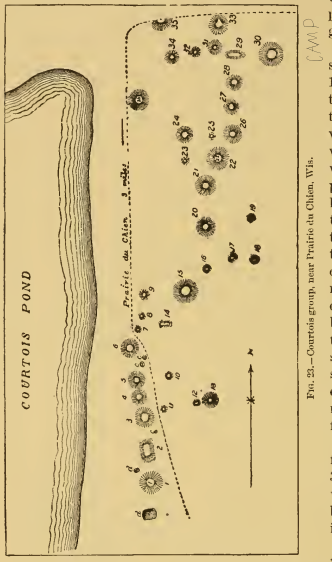
About three miles north of Prairie du Chien lies the Courtois Group, a collection of typical conical mounds located in Section 12, Township 7 North, Range 7 West. The arrangement is shown in Figure 23 of the original survey.
Mounds 1 to 9 sit on a long, narrow, sandy ridge about 70 to 80 feet wide that runs north–south. This elevation is just high enough to stay above the Mississippi River’s flood level. The remaining mounds, 10 to 33, are scattered across the adjacent fields.
Mound 1 is circular, rounded on top, 60 feet wide at the base, and 3 feet high. It is built from dark sandy loam.
Mound 2 is an oblong, flat-topped structure measuring 60 feet in length, 35 feet in width, and 3 feet in height. A French settler once built a house atop it, and signs of plowing or grading suggest that its original form has been altered.
Mound 4 closely resembles Mound 1 but stands 5 feet tall. Earlier excavations yielded some artifacts, though details were lost. It contains three layers: a 2½-foot upper layer of black sandy loam, a thin middle band of silvery sand, and a 2-foot base of dark muck mixed with sandy loam. A later reexamination revealed only a few freshwater shells.
Mound 5 is conical, 40 feet in diameter, and 3½ feet high. It had been previously opened by a trench cut from north to south. Excavators uncovered decayed human bones, disturbed by earlier diggers, but their position indicated that the burials were folded, or flexed, rather than extended. The remains rested directly on the gravel ridge beneath the mound, suggesting that the builders cleared away the surface soil before interment. Only a few scattered shells were also found.
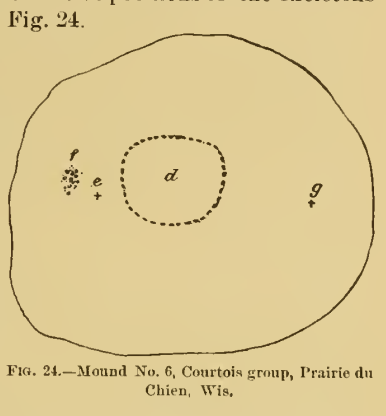
Mound 6 is similar in size and form to Mound 1, standing 4 feet high and made entirely of dark sandy loam like the surrounding soil. Figure 24 depicts the arrangement of the burials and artifacts found within. On the western side, about 2 feet below the surface, was a small deposit of decayed freshwater shells. Nearby, a folded adult skeleton lay with its head to the south and face to the west. A small stone perforator was placed beneath it, and an arrowhead above. The bones were fragile and broken—apparently damaged prior to burial.
At another point within the same mound, the natural surface had been dug out about a foot deep over an area roughly 12 feet wide. In this space lay six or seven folded adult skeletons, oriented in different directions. All were so deteriorated that their skulls could not be preserved.
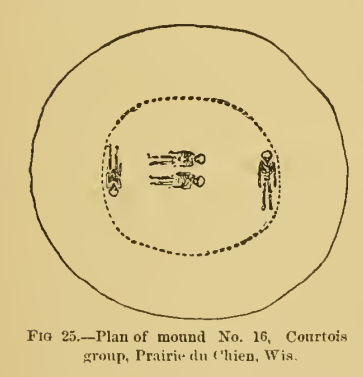
Mound 16 (mentioned later in the field notes) was of a similar composition to the surrounding soil and about 5 feet high. Near its center, two folded skeletons were discovered 2 feet below the surface, both with heads toward the northeast. Beside them were two pots—one upright, the other on its side—with the latter containing a lump of lead ore. Under one skull were two perforated bear teeth. Several soft sandstone fragments were also found nearby, under which lay decomposed bones from another burial.
Beside this mound was a pear-shaped ridge of earth, about 40 feet long, 10 feet wide at its broadest point, and 2 feet high. A trench dug through it revealed nothing except ordinary soil.
Finally, Mound 23 measured 15 feet across and 1 foot high. It contained a single extended burial lying on its back, head toward the southeast, with a broken pot nearby.
The surrounding field surface is uneven, as though earth was gathered from the immediate area to construct the mounds, leaving shallow depressions around them.
Gallery
Discussion (0)
Please sign in to join the discussion
No comments yet. Be the first to share your thoughts!