Whispers of Mitla: Palaces, Pyramids, and the Vanished City
"We woke at daybreak in the small town of Tlacolula, roused by the sharp voices of choirboys practicing in the church just outside our makeshift hotel. The church itself, beyond its music, held a quiet treasure: heavy pieces of antique solid silver that had somehow escaped confiscation during Mexico’s turbulent struggles between church and state in the reform era. As we watched, a young Zapotec man carefully polished these silver pieces at the doorway, unaware that he was about to be “recruited” into our curious expedition.
Our traveling companion, Dr. Batres, was on a personal mission. He sought what he called “typical Zapotec types” to present at an upcoming congress of Americanists in Mexico City, where he planned to lecture on the physical characteristics of Mexico’s ancient peoples. He had already “collected” Tarascans, Aztecs, and Toltecs near the capital; here in Oaxaca, he hunted for zapotecos with what he claimed was the classic profile: a long face and a prominent, hooked nose. The local political chief of Tlacolula, a sharp-eyed older man with a soldier’s bearing, embraced this “man-hunt” with enthusiasm, marching group after group of villagers before us, each man’s features inspected like specimens. Most villagers were understandably suspicious of the offer: paid passage to Mexico City, simply to be exhibited for the shape of their nose. Yet the young men cleaning silver at the church needed no convincing. They eagerly volunteered, drawn by the promise of witnessing the grand coronation of the Virgin of Guadalupe. One of them would become the leader of three Zapotec men chosen to accompany us, appearing from time to time on our journey—solemn, dignified, and shyly amused by their new roles.
Leaving Tlacolula, our little procession set out for Mitla, about eight miles away, escorted by the Jefe Político, who now served as guide and friend. In Mitla we found an old hacienda transformed into a simple hotel; its courtyard shaded by orange and pomegranate trees held a surprising harmony of parrots and even a monkey, adding a touch of tropical whimsy. Beyond the courtyard, the present-day village of Mitla sprawled in modest cane and adobe huts, a poor shell draped over the bones of a once-great city. Children and youths lined our path, offering us worn idols, masks, and beads dug from ancient palaces and tombs—an informal market of relics. Their voices, especially those of the girls selling small treasures, carried a plaintive sweetness reminiscent of the water carriers along the Nile, yet the children here were healthier, their clear eyes unstung by the diseases that plague Egypt.
At the edge of the village we reached the first of ancient Mitla’s secrets: a recently opened stone tomb, plain and unadorned. Around it rose small earthen mounds, weathered by centuries of wind and rain until they seemed like natural hills. Only when cut open did they reveal their human design. Dr. Batres declared them miniature versions of the great pyramids of the Sun and Moon at Teotihuacan near Mexico City, constructed with similar materials and methods. The largest pyramid at Mitla rose just west of the main palace complex. Its summit now held a small, shabby chapel, the Spaniards’ Christian crown built atop what had once supported an indigenous temple.
The pyramids of Mexico differ from those of Egypt. In Mexico they were broad, flat-topped foundations for temples and palaces, built mostly of earth or brick and meant to be climbed by stairways. Egyptian pyramids, in contrast, were steep-sided tombs of solid stone, pushing upward to a sharp apex and never intended as platforms for structures. Mexican builders spread their pyramids wide to ease the climb, while Egyptian architects sacrificed accessibility for sheer height and monumentality.
A short walk east of the chapel-topped pyramid brought us to Mitla’s most impressive remains: the ruins of a great palace. Four buildings once stood around a central courtyard, each raised on a low platform of earth and stone. Today, only the northern structure survives in recognizable form, its long façade facing the court. The eastern and western buildings remain as scattered fragments, and the southern one has vanished altogether. The preserved façade of the north building, with its three doorways, reveals Mitla’s most striking art: intricate stone mosaics.
The walls are faced with large blocks of stone, assembled without mortar into geometric panels of different sizes. Within each panel, countless small stones are fitted together to create “grecque” patterns—sharp-edged, angular designs reminiscent of Greek or Roman meanders, yet unlike anything found in other ancient cities of the Americas. These mosaics are not simple surface decorations; each stone is cut and set so that the pattern is built into the wall itself, giving a sense of depth and precision. The motifs, always angular and repeating, suggest a lost symbolic language that no inscription now explains.
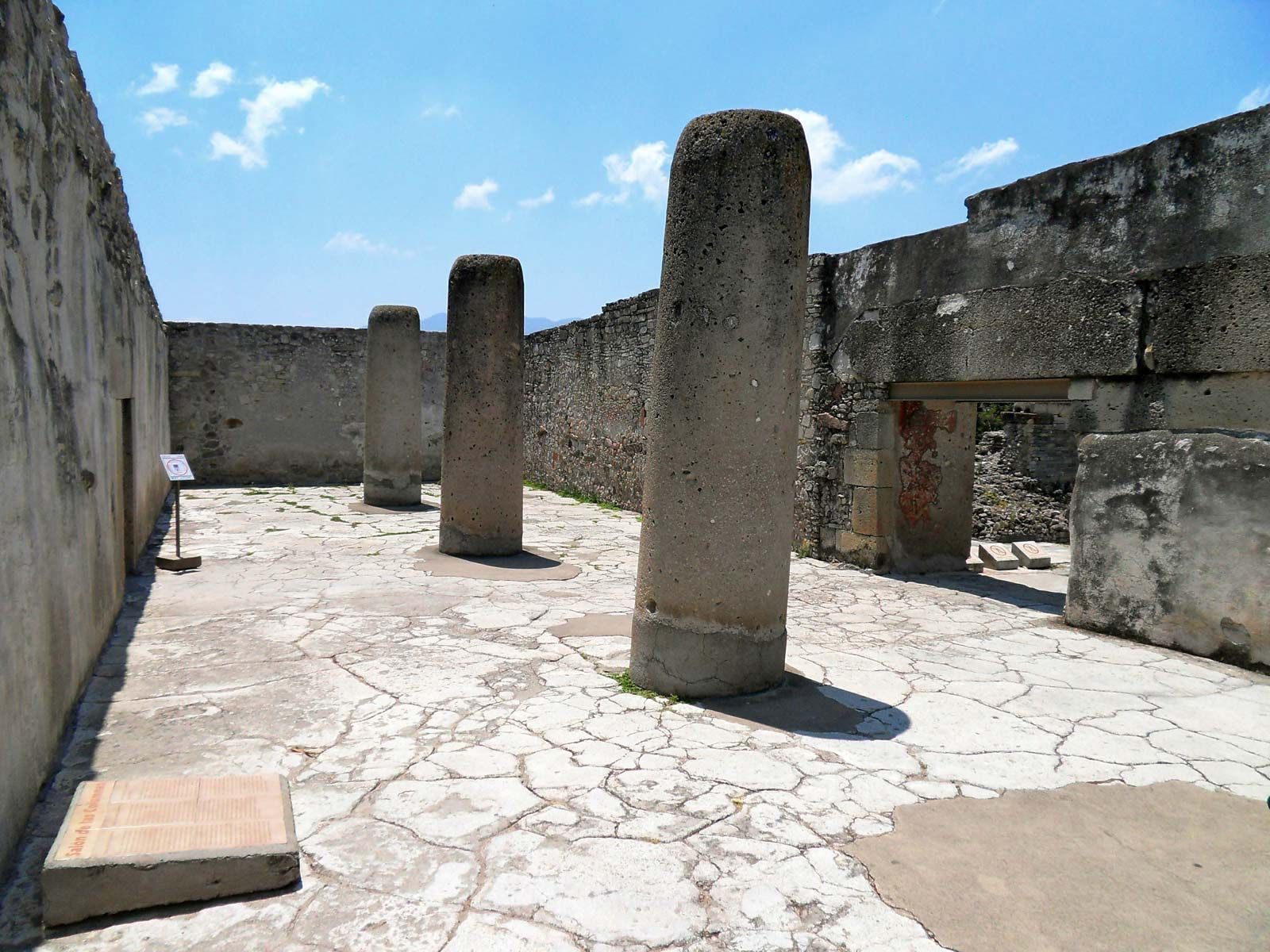
Within the palace stands a small courtyard, ringed by rooms whose walls carry bands of the same mosaic ornament. When we arrived, the scene was quietly theatrical: the Jefe Político of Tlacolula posed proudly in one doorway, framed by gray stone and patterned panels, like a living remnant of two worlds—indigenous and colonial—meeting atop the ruins of a third, older civilization. Columns—small by Egyptian standards—stand in one hall, giving the place its modern nickname, the “Hall of Columns.” Here again, the comparison to Egypt falters, not because columns are absent, but because they are so modest, dwarfed by the memory of Karnak’s forest of stone.
South of this palace lies another ruined complex, once formed by four buildings around a central court. Here, the most remarkable feature is hidden below ground: an underground gallery in the form of a cross. A narrow staircase descends into the earth, leading to a cool, shadowed chamber. This subterranean passage, long rumored to conceal treasure, has stirred generations of speculation and myth. To some, it hints at secret hoards of gold and jewels; to others, it suggests something even more valuable—the concealed spiritual and ceremonial knowledge of the Zapotecs, buried with their dead and their gods.
Faint traces of fresco paintings cling to some walls: figures, symbols, and colors almost erased by time and rain. What remains is barely legible, and every passing year washes away more of this ghostly script. Without a key—without a “Rosetta Stone” for Mitla—these designs remain mute. The palace walls, mosaics, columns, and underground chambers hint at a complex ceremonial and political life, but the precise beliefs and stories once held here are lost.
Mitla’s ruins do not overwhelm with sheer bulk. These are not colossal towers touching the sky but low, wide structures emphasizing surface, pattern, and refined masonry. Their power lies less in height than in the delicate, deliberate craft of their ornament. Where Egypt preserved vast stone temples and tombs, here in Mexico the enduring monuments are palaces; the great wooden or adobe houses of rulers in Egypt are gone, while in Mitla the royal residences remain, though broken and incomplete. Early explorers compared these palaces to the works of Greece and Rome, praising their harmony and the elegance of their designs, and imagining them in their original state—walls plastered smooth, colors bright, mosaics crisp and sharp.
Standing among these ruins, the imagination fills what time has stripped away. One can almost see the streets of Mitla stretching out into the valley, lined with houses, pyramids, and temples. Smoke rises from sacred fires; processions climb pyramid steps; priests perform rites in painted chambers; and somewhere beneath the stone, in hidden galleries and tombs, the dead are laid to rest with offerings, their memory guarded by the very patterns carved into the walls above. The present village, poor and dusty, clings to the site like a thin veil laid over the vanished grandeur beneath. The children selling idols at the roadside stand where once nobles walked, and the chapel on the pyramid’s summit replaces an older temple whose name is forgotten.
Mitla today is one of several great ancient centers of Mesoamerica, akin in fame to Palenque, Uxmal, and Copan. Each of these cities hints at connections across oceans—resemblances in form to Egypt, to Cambodia, to distant shores—but whether those connections are historical or only the product of similar human imagination is still debated. What is certain is that Mitla, with its mosaics, low pyramids, underground chambers, and strange silence, remains a place where the past presses close to the surface. The visitor walks between eras: the colonial church bells of Tlacolula, the Indian village of today, and the stone geometry of a civilization whose voice has faded into the desert wind."
Identifying the sites mentioned
- Tlacolula: This is Tlacolula de Matamoros, a town in the Central Valleys of Oaxaca, famous for its church and Sunday market.
- Mitla: This is San Pablo Villa de Mitla (commonly just “Mitla”), the archaeological site and adjacent town in Oaxaca’s Tlacolula Valley.
- Main palace group at Mitla: This corresponds to the principal palace complex at Mitla’s archaeological zone, including the so‑called “Grupo de las Columnas” (Group of the Columns) and “Grupo de las Iglesias” (Group of the Churches).
- “Hall of Columns”: This is the Column Hall within Mitla’s Column Group, notable today for its standing stone columns.
- Chapel-topped pyramid at Mitla: This describes the low platform/pyramid at the site where a colonial-era chapel was built atop a pre‑Hispanic structure.
- Teotihuacan pyramids: The “pyramids of the Sun and Moon” at Teotihuacan, near modern-day San Juan Teotihuacan in the State of Mexico.
- Cholula pyramid: The Great Pyramid of Cholula (Tlachihualtepetl) in San Pedro Cholula, Puebla, which today also supports a church on its summit.
- Other cities used for comparison: Palenque (Chiapas), Uxmal (Yucatán), and Copan (Honduras), all still known by those names as major Maya or related archaeological sites.
Reader’s notes on time and voice
- The narrative voice clearly belongs to a late‑19th‑ or early‑20th‑century traveler, not a modern observer. The language used for Indigenous people, the casual “collecting” of villagers as “types,” and the fixation on physical features reflect attitudes and anthropology of that era, not today.
- The description of silver surviving the Reforma confiscations, the reference to an upcoming “congress of Americanists,” and the way European explorers (Humboldt, Dupaix, Charnay) are cited all indicate a historical account, likely written around the late 1800s to very early 1900s, then retold.
- To a modern reader, the piece may feel surprisingly vivid and contemporary in its travel details, but the social context, racial language, and treatment of archaeology (buying idols from children, casually disturbing tombs) firmly place it in the past. This story should be read as a period travelogue, filtered through the author’s biases and the colonial scientific attitudes of its time, rather than as a report of recent events.
https://www.loc.gov/resource/sn83045462/1896-02-08/ed-1/?sp=16&q=Arkansas+Mounds+skeleton&r=0.273,0.032,0.267,0.173,0
Gallery


Discussion (0)
Please sign in to join the discussion
No comments yet. Be the first to share your thoughts!