Unveiling the Lost Amazons: Harold T. Wilkins' Map and the Enduring Legend of Warrior Women in South America's Jungles
In the annals of exploration and ancient mysteries, few tales captivate like the legend of the Amazons—fierce warrior women who ruled matriarchal societies, wielding power in a world dominated by men. But what if these weren't just Greek myths, but real remnants of a lost civilization hidden in the heart of South America? That's the astonishing claim made by British explorer and author Harold T. Wilkins in his mid-20th-century newspaper articles, published in The American Weekly. Drawing from forgotten Spanish manuscripts, indigenous testimonies, and colonial archives, Wilkins presents "astonishing evidence" of a race of white warrior women, unclothed and unyielding, surviving among the ruins of a mysterious, long-perished civilization in Brazil's unexplored jungles.
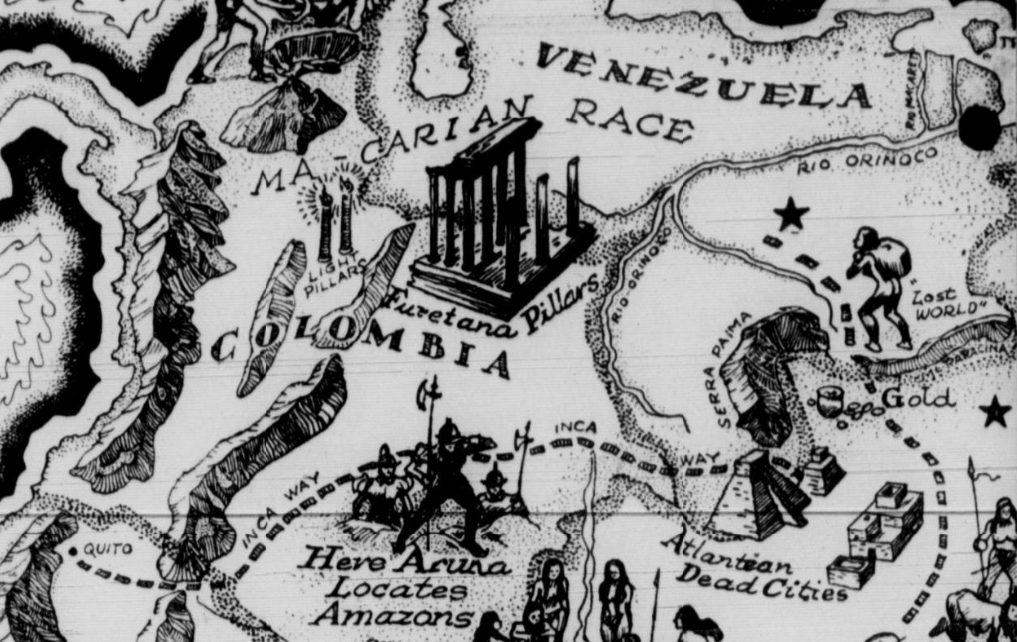
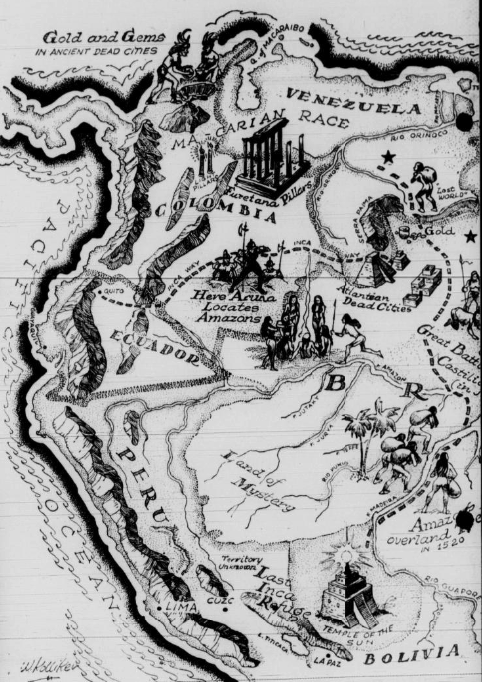
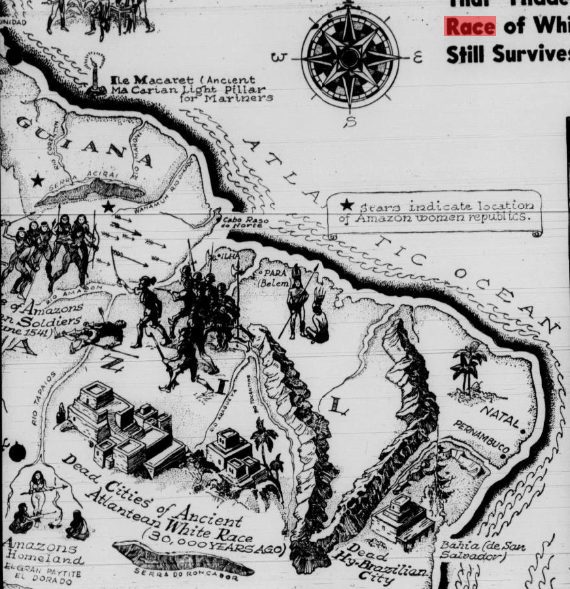
At the center of Wilkins' narrative is a fascinating map that blends historical routes, mythical locations, and tantalizing clues to lost worlds. This map, illustrated in his articles, isn't just a geographical sketch—it's a portal to a forgotten era. Let's break it down and explore the story it tells, pieced together from the two parts of the article (which appear to have been split across pages, complete
with dramatic illustrations like Rubens' painting "The Battle of the Amazons" and portraits of key figures).
The Map: A Guide to Hidden Republics and Golden Cities
The map focuses on northern South America, spanning modern-day countries like Colombia, Venezuela, Ecuador, Peru, Bolivia, and Brazil. It's adorned with symbolic elements that highlight Wilkins' key arguments:
- Stars Indicating Amazon Women Republics: These are the map's standout features, pinpointing supposed strongholds of the Amazons. Clusters appear along the Amazon River (labeled as Rio Maranon in its upper reaches) and its tributaries, such as the Rio Negro and Rio Beni. Wilkins suggests these mark "republics" where women lived independently, ruling over men and taxing nearby tribes with feathers for their temples. One notable spot is near the juncture of the Coca and Napo rivers, where Spanish explorer Francisco de Orellana allegedly encountered them in 1541.
- Routes of Conquest and Exploration: Arrows trace the perilous journeys of 16th-century Spanish conquistadors, including Orellana's infamous descent down the Amazon River. Starting from Quito in Ecuador, the path winds through the high Cordilleras, across raging torrents, and into dense jungles—described as "man-tight" and "abominable woods." The map also nods to earlier Inca routes, like those of King Narva of Peru, who testified to the Amazons' existence in 1533.
- Lost Cities and Ancient Sites: Labels like "Dead Cities of Ancient White Race" dot the Brazilian Matto Grosso and Bolivian highlands, evoking visions of golden ruins with Greek-like inscriptions and Phoenician influences. Wilkins points to abandoned metropolises, such as those near Lake Titicaca or the Inca capital of Cuzco, where matriarchal societies allegedly thrived before mass migrations due to upheavals or conquests. A "Great Dead City" is marked in northwest Bolivia, complete with an old painting reference from a La Paz museum.
- Geographical and Symbolic Details: The map includes the Atlantic Ocean to the east, the Pacific to the west, and features like the "Hell" photo by Wilkins himself (likely a dramatic shot of volcanic or jungle terrain). It also highlights "Gold and Gem" locations in ancient dead cities, tying into the conquistadors' gold-hungry quests. Illustrations of temples, battles, and indigenous figures add a narrative flair, emphasizing the clash between Stone Age warriors and armored Europeans.
This map isn't modern cartography—it's a speculative reconstruction based on Wilkins' research, blending fact with folklore. He argues these sites hold the key to understanding matriarchies, where women held "mystic secrets" of engineering, sanitation, and governance, leaving men as laborers.
The Story: Battles, Betrayals, and Enduring Mysteries
Wilkins' articles weave a gripping tale rooted in historical accounts. He recounts Orellana's 1541 expedition, where 50 Spaniards, sent ahead for food, deserted their comrades and floated down the Amazon. Along the way, they clashed with "companyaras" (fighting women) in a fierce battle near a stone-built town. Friar Gaspar de Carvajal, an eyewitness, describes naked Amazons of "great stature" charging with bows and spears, nearly overwhelming the armored invaders despite their firearms and crossbows. The Spaniards escaped, but the encounter fueled legends of "golden cities" ruled by women.
Wilkins connects this to broader pre-Columbian history: ancient migrations from the Andes to the Amazon basin, abandoned cities like those in the Matto Grosso, and indigenous reports of "Aikembennans" (women who live alone) in Guiana. He speculates these Amazons were heirs to a white, advanced race—perhaps linked to Phoenicians or Atlanteans—whose knowledge vanished when the women rulers departed, leaving cities to decay.
But is it true? Wilkins acknowledges skepticism, comparing it to the "myth" of Troy before its discovery. Modern explorers like Colonel Percy Fawcett (who vanished in 1925 searching for similar lost cities) believed in it, and Wilkins calls for airship expeditions to penetrate the "green hell" of the jungles. Today, we know some elements ring true—indigenous tribes with strong female roles exist, and archaeological finds reveal complex pre-Columbian societies. Yet, the naked warrior queens remain elusive, perhaps romanticized by colonial biases.
Why This Matters Today
In our era of satellite mapping and DNA archaeology, Wilkins' map reminds us of the thrill of the unknown. South America's jungles still hide uncontacted tribes and undiscovered ruins—could matriarchal holdouts persist? His work inspires questions about gender roles in ancient societies and the biases in historical records. If you're an adventurer at heart, this legend beckons: perhaps the Amazons' secrets await in the Matto Grosso.
What do you think—historical fact, exaggerated tale, or something in between? Share your thoughts in the comments, and if you're planning a jungle trek, pack Wilkins' map!
https://www.loc.gov/resource/sn88063294/1941-12-07/ed-1/?dl=page&q=vanished+race&sp=102&st=image&r=0.476,-0.064,0.825,0.536,0
Gallery
Discussion (0)
Please sign in to join the discussion
No comments yet. Be the first to share your thoughts!