Unearthing the Galley Hill Man
# Unearthing the Galley Hill Man: A 1911 Tale of Ancient Humanity
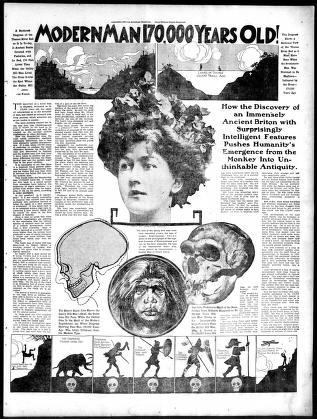
In 1911, a fascinating article appeared in the *American-Examiner*, detailing the discovery of a fossilized human skeleton at Galley Hill, near Gravesend in England. The piece, copyrighted in 1911 with Great Britain rights reserved, presented the find as a 170,000-year-old "modern man" that challenged prevailing ideas about human evolution. The information in this blog post is drawn directly from that historical article, preserved in a PDF document titled "Ape-Like Prehistoric Skull of the Neanderthal Type.pdf."
### The Discovery at Galley Hill
The skeleton, dubbed the Galley Hill Man, was unearthed by Robert Elliott, a London printer and amateur archaeologist. He found it in a deep gravel pit along the Thames River, eight feet below the surface in a layer known as the 100-foot terrace—an ancient riverbed from post-glacial times. The bones were soft and fragile but complete, lying in what was once the bottom of a pool in the old Thames.
According to the article, the age was calculated based on the river's erosion rate: the current Thames bed is 170 feet lower than the discovery site, and observations suggested the river lowered at one foot per thousand years. This placed the skeleton at 170,000 years old. The remains showed a man about five feet tall, with a long, narrow head, short legs, large teeth, a prominent jaw, retreating chin, and forehead. His brain size was slightly below average for modern humans but still indicative of high intelligence. Professor Arthur Keith of the Royal College of Surgeons examined it and noted that it represented a modern type of man, shedding simian traits far earlier than expected.
The article highlighted flint implements and remains of mammoths and other post-glacial animals in the same gravel, suggesting the man lived in the Paleolithic era. He could make fires, weapons like spears and axes from flint, and possibly build houses—marking significant progress from animal-like existence.
### The Puzzle of Human Antiquity
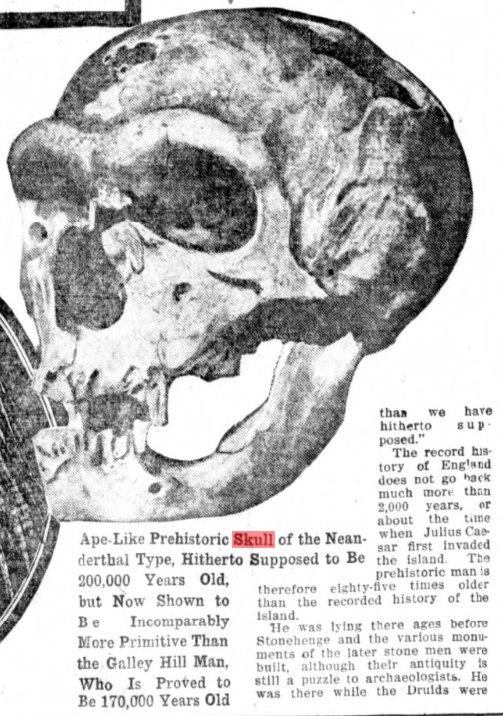
The find raised a profound question: if this 170,000-year-old man was nearly as developed as modern Europeans, how much older must more primitive types like the Neanderthal man be? The article described the Neanderthal skull, discovered in 1856 in Germany, as having enormous eyebrow ridges, no forehead, and a projecting jaw—distinctly ape-like characteristics. It noted similar finds in Le Moustier, France, and Heidelberg, Germany, with the earliest estimates at 200,000 years old.
The contrast was stark: the difference between Neanderthal and Galley Hill Man seemed a hundred times greater than between Galley Hill and modern man. This implied Neanderthal could be 17,000,000 years old, pushing human origins back to unthinkable antiquity, potentially before life on Earth according to some geologists. The piece pondered whether evolution was slow or if modern man appeared suddenly, even aligning with biblical creation ideas. It also mentioned experiments with moth eggs producing sudden changes, supporting abrupt development over gradual evolution.
The article compared the Galley Hill Man's potential wife to a modern Englishwoman like the Countess of Westmoreland, rather than the reconstructed ape-like mate of Neanderthal man by artist Gabriel Max. It emphasized how this ancient Briton predated recorded history by 85 times, lying undisturbed through eras from Druids to Romans, Saxons, Normans, and Cromwell.
### Relevant Modern Context on the Neanderthal Type
Regarding the "Ape-Like Prehistoric Skull of the Neanderthal Type, Hitherto Supposed to Be 200,000 Years Old," modern assessments have refined our understanding. The Neanderthal remains were first discovered in 1856 in the Neander Valley, Germany. Current scientific dating places Neanderthals as having lived from approximately 400,000 to 40,000 years ago, across Western Eurasia. They coexisted with early modern humans and interbred, contributing to non-African human DNA today.
### Modern Assessment of the Galley Hill Find
Subsequent analysis has determined that the Galley Hill skeleton is not ancient but a recent intrusion—a modern human burial that ended up in older geological layers. This was confirmed through methods like fluorine dating, aligning with geological evidence. The original discovery occurred in 1888, not directly in 1911 as the article's reporting might suggest.
This 1911 account captures the excitement and debates of early paleoanthropology, reflecting the era's evolving theories on human origins.
Gallery
Discussion (0)
Please sign in to join the discussion
No comments yet. Be the first to share your thoughts!