🔥 “The Red-Haired Mummy of New Mexico: A Hunter’s Discovery That Challenges History” 🔥
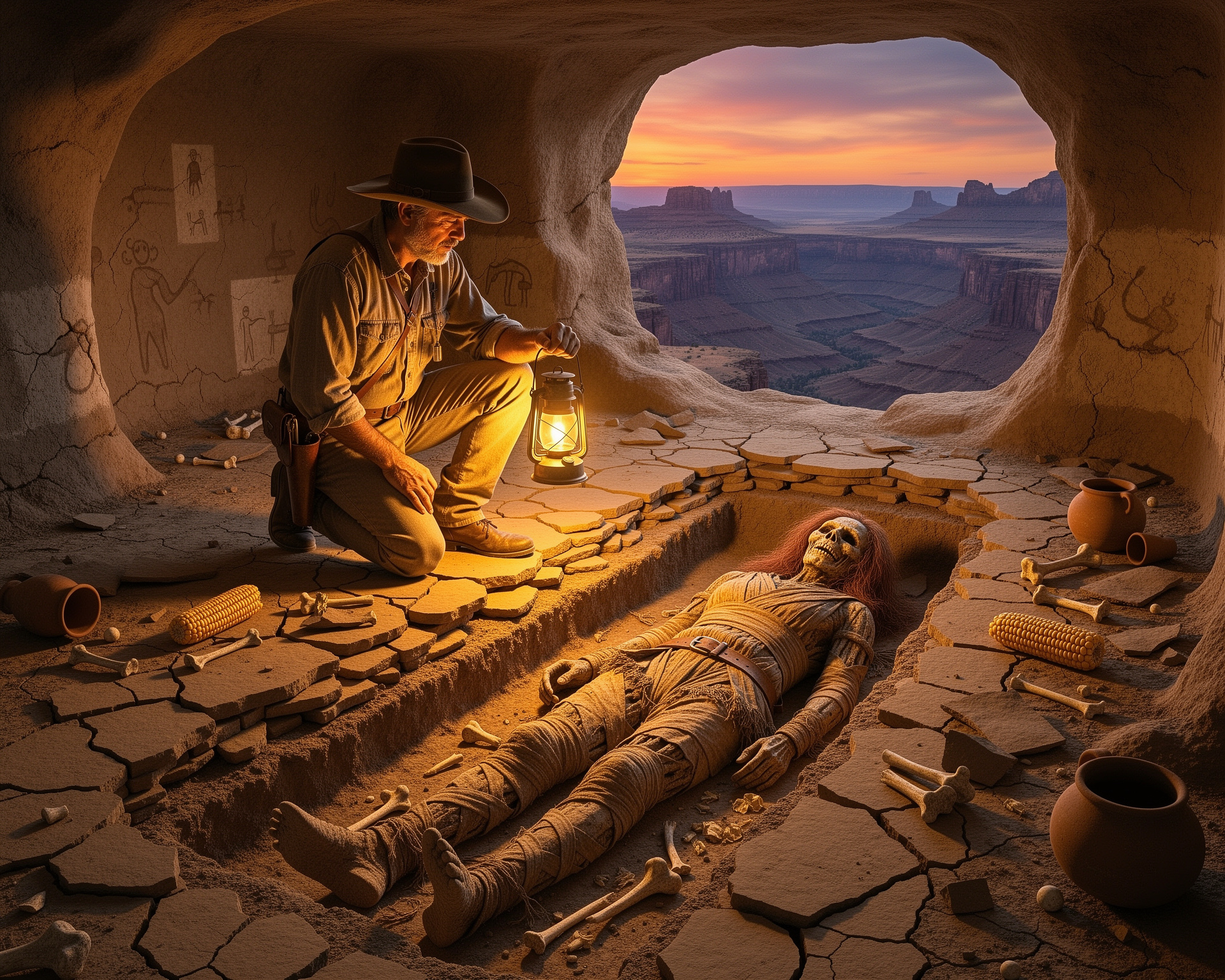
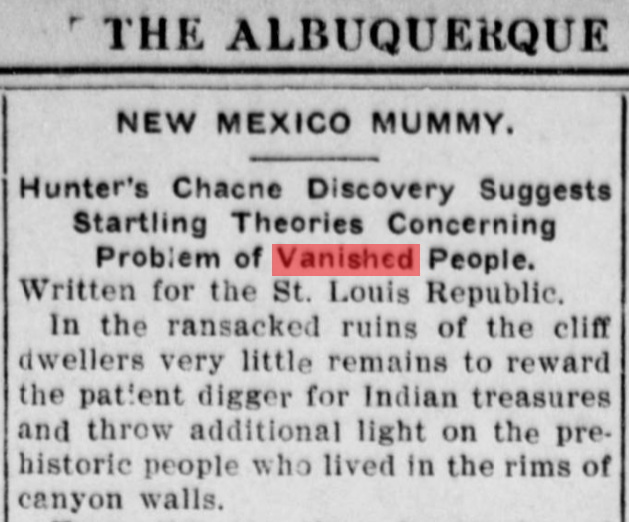
More than a century ago, in the rugged canyons of southern New Mexico, a hunter named John Tex made a discovery so unusual that it still puzzles researchers and historians today. What began as a chance exploration through the sandstone ravines of Socorro County, near the Rio Grande del Norte, resulted in the unearthing of a mummy with features unlike any known remains from the ancient Southwest.
Tex, a seasoned frontiersman who had lived among the descendants of the Pueblo builders since the 1880s, was riding through the plains of San Augustine in late January when he spotted what appeared to be a cave opening high in a canyon wall — nearly 200 feet above the basin below. Driven by curiosity, he climbed the steep rock face to investigate. Inside the dark recess he found the ruins of a once‑inhabited dwelling, partially collapsed and filled with sand and debris.
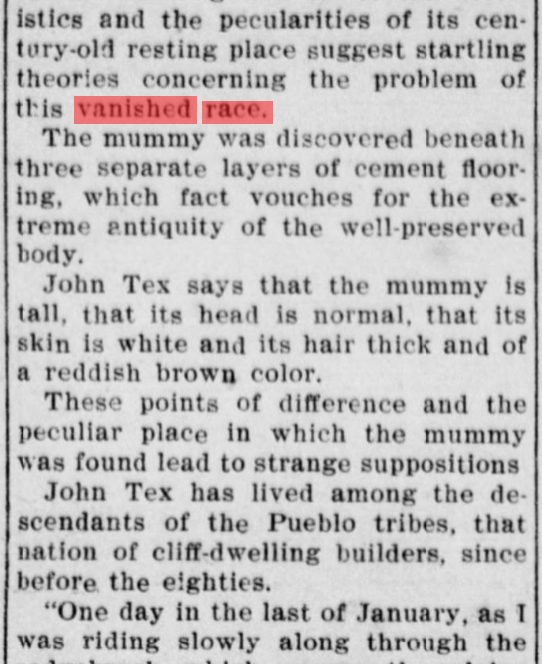
Examining the site, Tex began to dig through the accumulated earth, layer by layer. At first, he found only sand and refuse — corncobs, ash, pottery shards, and animal bones. But as he dug deeper, his shovel scraped against something hard and smooth. It was an ancient clay‑cement floor, the sort used in the communal houses of prehistoric Pueblo construction.
Following a hunch that the ancients often buried their dead beneath the floors of their homes, Tex broke through the hardened clay — only to discover another cement layer below it. Then another. In all, there were three distinct floors, each separated by deposits of refuse, charcoal, and domestic remains — evidence of a dwelling rebuilt repeatedly over generations. Beneath the lowest of these, Tex finally struck what appeared to be a burial chamber.
There, sealed for what could have been many centuries, he found the mummified remains of a tall individual, remarkably preserved beneath the ancient cement. The body’s skin appeared light in color, and its hair was thick and reddish‑brown, unlike the dark hair commonly associated with Indigenous peoples of the Southwest.
To those who later heard the account, the find raised astonishing questions. Who was this individual sealed beneath three generations of habitation? Could the unusual physical traits point to contact with an unknown or now‑vanished group? Early archaeologists debated what to make of the description, and whether it hinted at a lost chapter in the prehistory of the American desert.
Though time has eroded both the site and the evidence, the story of John Tex’s discovery — the red‑haired mummy beneath the canyon floors of New Mexico — endures as one of the most mysterious finds ever reported from the ancient cliff‑dwellings of the Southwest.
More than a hundred years later, it remains a haunting reminder of how much of America’s ancient past may still lie hidden beneath the dust and stone of forgotten canyons.
Source: https://www.loc.gov/resource/sn84020613/1903-03-30/ed-1/?sp=5&q=Vanished+race&r=0.178,0.012,0.414,0.247,0
Gallery
Discussion (0)
Please sign in to join the discussion
No comments yet. Be the first to share your thoughts!