The Ozark Oracle: Dr. Curry, Grand Gulf, and the Lost Records of Ancient America
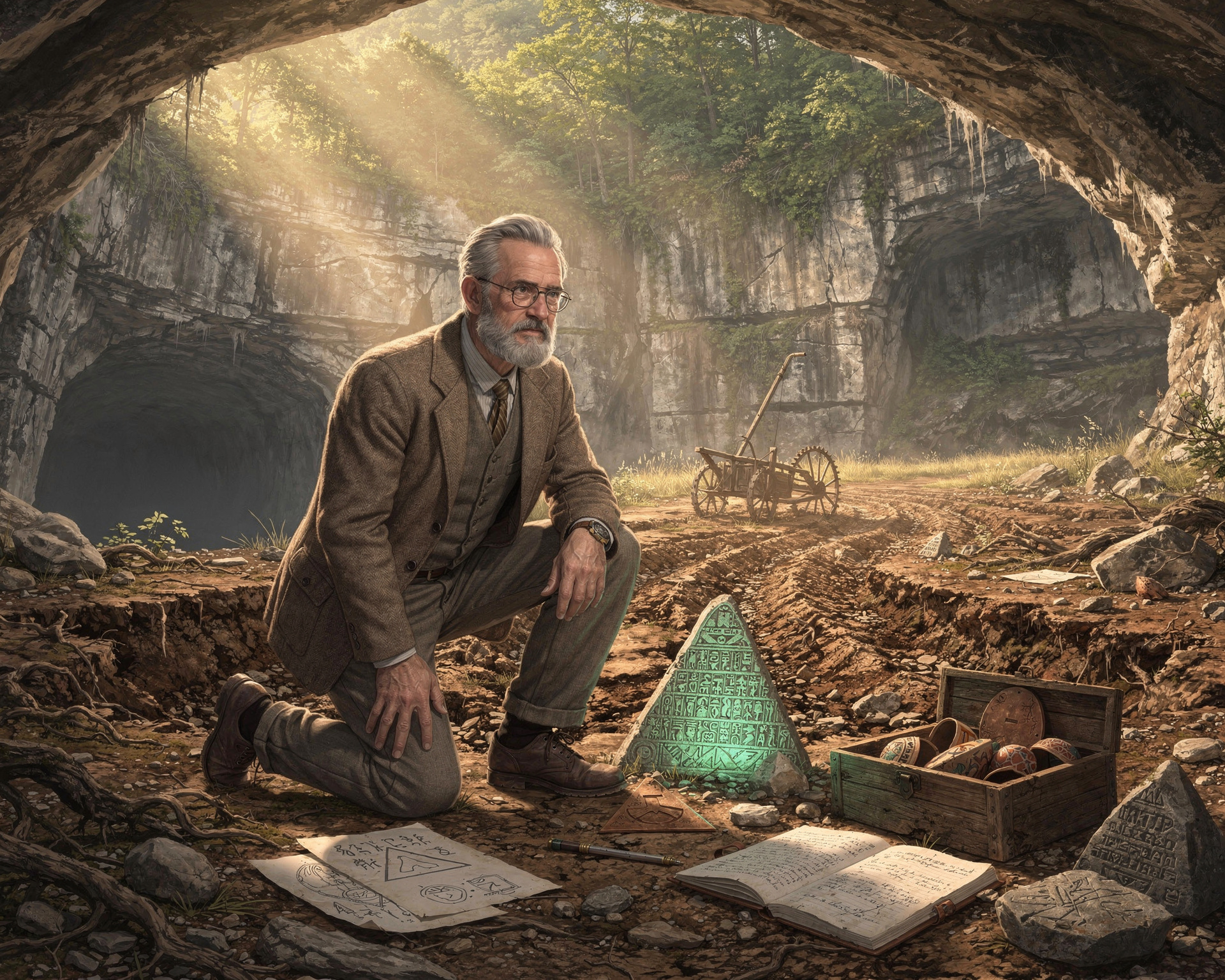
Hidden in the steep hollows and limestone ridges of the Missouri Ozarks, a quiet, self-taught archaeologist once believed he held the keys to a forgotten chapter of human history. In the early nineteen hundreds, Dr. E. B. Curry of Howell County, Missouri, claimed to have deciphered stone and metal records that told the story of ancient nations, vanished cities, and a war that drove the mound builders from North America.
A Scholar in the Ozark Backwoods
About fifteen miles from West Plains, in the southeast corner of Howell County, Dr. Curry lived a surprisingly scholarly life in the seclusion of the Ozark Mountains. By the time a reporter visited him in early September nineteen oh three, he was in his late sixties and hard at work on a series of books he said would trace human history “from the first man down to modern times.”
Curry’s path to this work was unconventional. He grew up on the shores of Allumette Lake in Canada, received limited schooling in a frontier settlement, and later attended Victoria College at Cobourg, Ontario. Afterward, he went among Indigenous communities as a missionary, preaching and living closely with the people who adopted him as one of their own.
From them he learned something he believed was far more ancient than any written chronicle. Verses of poetry—ritual lines memorized and passed mouth‑to‑mouth “since time immemorial”—were, he was told, oral copies of records carved and engraved on stone and metal across the continent. That idea became the core of his life’s obsession.
Decoding Petroglyphs and Ancient Records
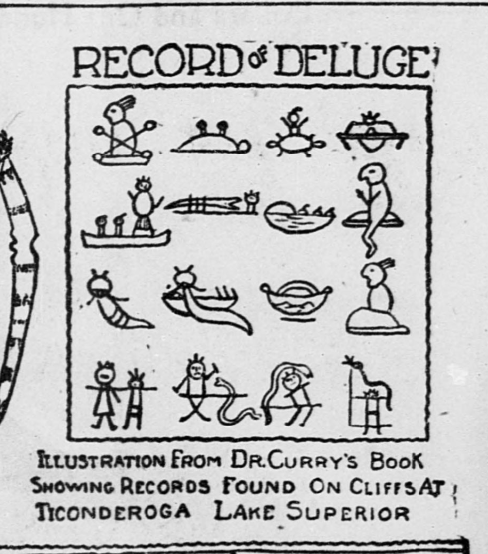
Guided by Indigenous informants, Curry began carefully studying the hieroglyphic carvings etched on cliffs along the Great Lakes. With their help he developed what he believed was a working knowledge of a prehistoric system of writing. From inscriptions on the north shore of Lake Superior and elsewhere, he became convinced that the most complete records of these ancient races were hidden far to the south, in the Ozark Mountains.
Those traditions pointed him to a place locals called Grand Gulf, just across the Missouri–Arkansas line in Oregon County. Grand Gulf is a vast collapsed cave and gorge, drained by an underground river that re-emerges at Mammoth Spring in northern Arkansas, about twelve miles away. According to Curry, cliff inscriptions on Lake Superior had explicitly marked the location of this cavern and hinted that important records were buried in its vicinity.
The Lost Tablet of Grand Gulf
In eighteen fifty‑six, Dr. Curry moved from Michigan to Howell County, settling only four miles from Grand Gulf and beginning his long search for the records the traditions had described. One inscription he had decoded years earlier spoke of a particular tablet hidden somewhere near the great cave. For eleven years he hunted for it, probing the ridges and fields around Grand Gulf, but eventually had to admit defeat.
The object surfaced not in a museum but under a farmer’s plow.
A local farm boy, working his field, struck a large, odd stone with his plowshare. When he levered it up, he found another stone beneath, much like the first. In trying to free it, the stone cracked—and out rolled a tiny cemented capsule from its center. Inside that capsule was a small triangular piece of tempered copper, scarcely an inch across, covered on three sides with minute hieroglyphics.
The boy kept it as a curiosity until he heard of Curry’s relentless search for “relics of past ages” and handed it over. For Dr. Curry, this was the prize he had hunted for more than a decade. He considered it the most valuable artifact in his entire collection.
According to his reading, the copper record described an event that had taken place ten thousand years earlier. At that time, he said, three nations occupied North America. When they formed a kind of ancient triumvirate, they forged a national emblem from three sacred symbols—each represented on one face of the tiny triangle.
On one side, Curry read the image of Namah, “the mother of the mound builders.” Another side bore the emblem of the “wise people of the Pacific Coast.” The third, he said, depicted a wolf, symbol of a people who had escaped from a land he called Tula. The two ends of the little copper triangle were oval and uninscribed.
The Battle Stone of Grand Gulf
Another relic, also uncovered by a farmer plowing near Grand Gulf, became Curry’s second great showpiece. This one was stone—thirty‑five pounds of carefully shaped rock, about eighteen inches long and a few inches thick, carved into a rough, pyramid‑like form. Its surface was incised with hieroglyphics that had been painted black. Remarkably, even after untold centuries in Ozark soil, the pigment still appeared bright and fresh.
Curry’s translation turned this stone into the chronicle of a cataclysmic war: “the greatest battle ever fought on the globe,” as the article summarized his claims. According to his reading, it was the war that finally expelled the mound-building peoples from the continent. The victors, he believed, were the direct ancestors of later North American Indigenous groups, whose oral traditions, he argued, echoed this same story of a great conflict in the distant past.
On the stone, Curry found a date: three hundred ninety‑seven A.D. That battle, fought some fifteen centuries earlier, was presented as the turning point that ended the age of the mound builders and ushered in the era of the ancestors of the historic tribes.
Lost Arts and Curious Instruments
The Grand Gulf relics were only part of Curry’s collection. To visitors, he liked to display a copper tool shaped something like a hoe, which he said had been used for corking large vessels. He had found it in a mound at St. Ignace, in the Straits of Mackinac. What fascinated him was that the handle and blade appeared to have been welded together and the copper tempered harder than steel. Both copper welding and such tempering, he insisted, were lost arts—evidence that these ancient peoples had been highly advanced metalworkers.
He also pointed out unusual pottery, finely made stone tools, and a curious white stone disk about three inches across, hollowed on both sides like a shallow bowl. Local Indigenous people on Lake Superior and in Mexico, he said, called this type of stone a “barometer.” According to their lore, the stone warmed and turned red about twenty‑four hours before a storm, then cooled and turned white again once the weather cleared. This particular specimen, Curry had found in southeast Missouri near the Mississippi River.
And then there was his living exhibit: a “mound builder corn.” Years earlier, a man named John Shannon had uncovered a pot of ancient corn kernels in a mound near Marked Tree, Arkansas, and tossed them aside, believing them spoiled. Rain revived them, and a single stalk sprouted. From that one plant came a line of corn with long ears and small, golden kernels. Curry acquired some of this seed, grew it on his own farm, and proudly showed visitors what he believed was the same variety grown by the mound builders centuries before.
Printing a Prehistoric History by Hand
Dr. Curry was not content merely to collect; he wanted to publish. In his Ozark home, with almost no budget and no formal printing background, he and his family set out to print and bind his multivolume history of the “prehistoric races of America.”
The introductory volume, titled The No‑Din, was his first completed work. On July first, eighteen ninety‑nine, without prior printing experience, he began the project. His two sons and two daughters learned typesetting, press operation, and bookbinding entirely by trial and error. Using a simple Washington hand press that printed sixteen pages at a time, they produced a first edition of six hundred copies. The plates were stereotyped so that future editions could be printed once the rest of the series was complete.
The engravings presented another challenge. Curry had no money for professional illustration plates, so he carved his own images by hand into slabs of local “cotton rock.” With homemade tools he ground the stone down to type height, then painstakingly chipped and scraped away everything but the lines of his drawings. Some cuts took him weeks to finish. From these stone blocks, he cast metal plates suitable for his press.
The No‑Din, he explained, recounted the earliest inhabitants of the North American continent—a land he identified with the biblical‑sounding “Land of Uz.” From the records he claimed to have read, he argued that these first settlers had come from another homeland he called Tula, traveling in an “air vessel” whose design he said he could reconstruct if he were younger and had the funds.
Lost Cities, Airships, and the Land of Uz
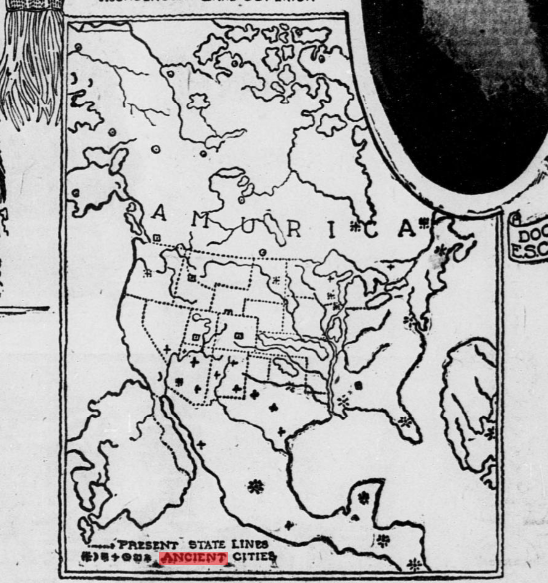
Curry’s reconstructions went far beyond Grand Gulf. He spoke of a great city that once stood where St. Louis and Memphis now lie, a capital he called “the City at the Wedlock of the Waters,” ruling over a northern land he named Uz. This metropolis, he believed, had been the seat of a civilization whose influence stretched from the Great Lakes to the Gulf of Mexico.
From his readings of cliff records and tablets, he told of Namah, the mother of the mound builders, who ruled a land he called Tia (or Tula), where a person’s lifetime was about a hundred years. He described signaling towers, vast reservoirs, and eventually a catastrophic earthquake in the year two thousand one hundred forty‑nine A.D.—a dating system clearly using some internal chronology, not our current calendar—that destroyed and submerged the great city.
To mainstream historians even then, Curry’s conclusions were speculative at best and wildly imaginative at worst. Yet his work drew the attention of serious scholars. Men such as Dr. Morehead of Andover and Professor Hallock of Washington, D.C., visited his Ozark home, examined his artifacts, and traveled with him to sites he believed were ancient mines and ritual centers. In southern Howell County, near the Arkansas line, Curry helped identify what he said was an ancient mine shaft later reused by modern prospectors; arrowheads found in its fill convinced him that prehistoric workers had been there first.
A Life’s Work in the Hills
By the time the article about him appeared in nineteen oh three, Dr. E. B. Curry was frail, in poor health, but still working toward his goal: to finish the last volume of his great history. Surrounded by his family, his home doubling as both farm and print shop, he seemed content. The reporter describes him as living “a happy and peaceful life,” driven by a single ambition—to see his story of the prehistoric races of America completed and preserved.
Whether Curry truly decoded a lost writing system or instead projected grand narratives onto enigmatic carvings is still an open question. His claims of ten‑thousand‑year‑old copper tablets and airships from Tula sit far outside accepted archaeological consensus. Yet his story fits perfectly into that liminal zone you love to explore: the frontier between documented history, folklore, and the possibility of forgotten knowledge.
For anyone fascinated by ancient mysteries, mound builder lore, and lost civilizations, the saga of Dr. Curry, Grand Gulf, and the Missouri tablets is less a solved case than an invitation—a dangling thread in the Ozarks, still waiting for someone to tug.
Source: https://www.loc.gov/resource/sn84020274/1903-09-06/ed-1/?sp=43&q=Arkansas+ancient+prehistoric+mound&r=-0.775,0.211,2.55,1.523,0
Gallery
Discussion (0)
Please sign in to join the discussion
No comments yet. Be the first to share your thoughts!