“Peculiar Skull Found in Oklahoma"
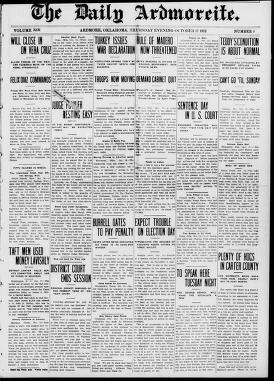
A 1912 newspaper blurb from Ardmore, Oklahoma describes a mysterious skull found along the Big Cedar River—an animal head with eye sockets “at least two inches across” and a brain cavity nearly human‑sized, so unusual that local doctors and “scientists” refused to even guess its species. No surviving reports, museum records, or follow‑up articles could be located in online archives, so the “peculiar animal skull” remains a single, tantalizing note in the historical record rather than a documented scientific case.
A strange skull on the Big Cedar
On October 16, 1912, a physician identified only as Dr. Strange from Hugo, Oklahoma was out hunting along the Big Cedar River, about fifteen miles north of Antlers in the piney foothills of southeastern Oklahoma. While there, he came across a skull that immediately drew attention when it was brought back to town, quickly becoming a minor sensation in the local press.
The Ardmore Daily Ardmoreite printed the story under the sub‑heading “Peculiar Skull Found,” framing it as one of those oddities that broke up the drumbeat of politics and court cases on the front page. It appears as a short column item rather than a headline feature, but the language makes clear that whoever wrote it thought this was something well outside the normal run of local hunting stories.
Features that baffled “local scientists”
What made the skull so disturbing to contemporary readers were two precise details: first, that the animal’s eye sockets were “at least two inches across,” and second, that its brain space was “almost as large as found in the skull of a human.” The article stresses that this brain cavity was “far in excess of any known wild animal of the present day,” hinting that even experienced woodsmen and doctors in the area had never seen anything like it.
In overall outline, the “skull proper” was said to resemble the head of an ordinary wild animal, which suggests it did not strike observers as human or obviously primate at first glance. Yet the proportionally huge orbits and inflated braincase pushed it outside familiar categories, leading the writer to emphasize that the eyes must have been of a “different size and width” than anything then living in the region.
A mystery without a paper trail
The Ardmore piece notes that “all of the local scientists” examined the specimen and that “few of them even venture a prediction” as to what sort of animal it belonged to, underlining the sense of bafflement. However, the article does not name any of these examiners, mention a museum, or provide a specimen number, and it gives no hint of where the skull went after the brief flurry of attention.
Searches through digitized newspapers and web archives for combinations of “Hugo,” “Antlers,” “Big Cedar river,” “Dr. Strange,” and “peculiar skull” around 1912 do not turn up any second article that clearly references the same find. Modern Oklahoma “skull” news items available online concern human remains or clearly identified historic burials rather than an anomalous animal cranium with oversized eyes and near‑human brain space.
Possible explanations and modern parallels
With no photograph, measurements beyond the “two inches” remark, or professional write‑up, the 1912 skull can only be interpreted through that single paragraph of descriptive journalism. Misidentification is the obvious mundane explanation—partial or juvenile skulls, marine mammals, and distorted remains can all look extremely strange outside their usual context, especially when filtered through the expectations of early‑20th‑century small‑town observers.
At the same time, the story fits neatly into a broader pattern that researchers of “old anomalies” will recognize: isolated newspaper reports of giant skeletons, odd skulls, and baffling remains that generated local excitement but never transitioned into formal science, often leaving no trace beyond a clipped column. In that sense, the “peculiar skull” of Big Cedar River now sits alongside reports of giant mound skeletons and out‑of‑place crania—part of a lost archive of mysteries that live on more in folklore and alternative history than in museum drawers.
Discussion (0)
Please sign in to join the discussion
No comments yet. Be the first to share your thoughts!