"Nephilim Skulls found in America?"

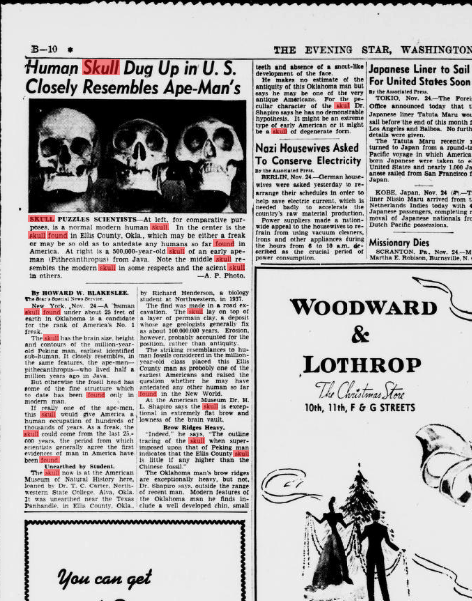
The Ellis County skull is one of the most intriguing “almost–fossil man” finds in the Southern Great Plains: a nearly complete human skull uncovered in 1937 in western Oklahoma that looked startlingly primitive in its vault, yet modern in its face and jaw, and ultimately left leading anthropologists admitting they could not fully explain it. Later discussion in regional archeological overviews still cites the Ellis County skull as a morphologically unusual but anatomically modern human cranium, found in sediments whose geologic context raised big questions about how long people have been in the Americas.
Discovery on Commission Creek
According to T. C. Carter’s 1942 paper “A Preliminary Report on the Ellis County Skull,” the skull was found in 1937 by two men, Richard Henderson and Earl Gourley, during road work along Commission Creek near the small community of Bishop in Ellis County, Oklahoma. It lay about 25 feet below the surface, on Permian clay and buried in sand and gravel on the south bank, exposed only because of a fresh road excavation that cut into the ancient deposits.
Carter notes that the skull was “almost complete” when recovered, with enough of every major bone present to allow a confident restoration of the cranium. That completeness is important: this was not a random fragment or isolated cap, but a reconstructed head that could be measured, compared, and photographed from multiple angles.
Primitive vault, modern face
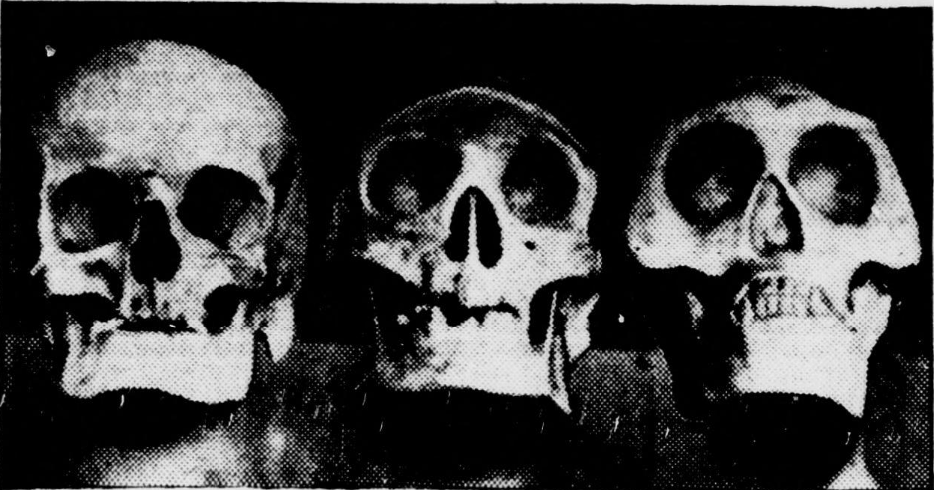
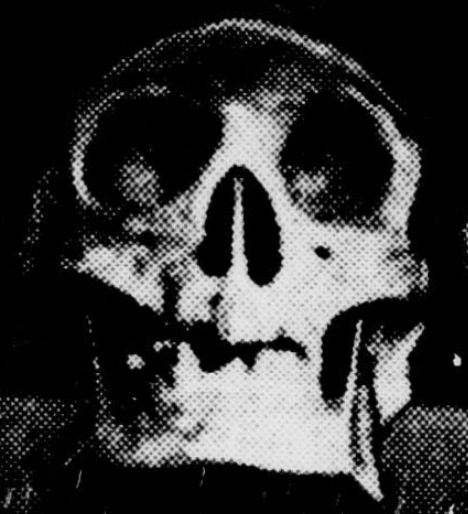
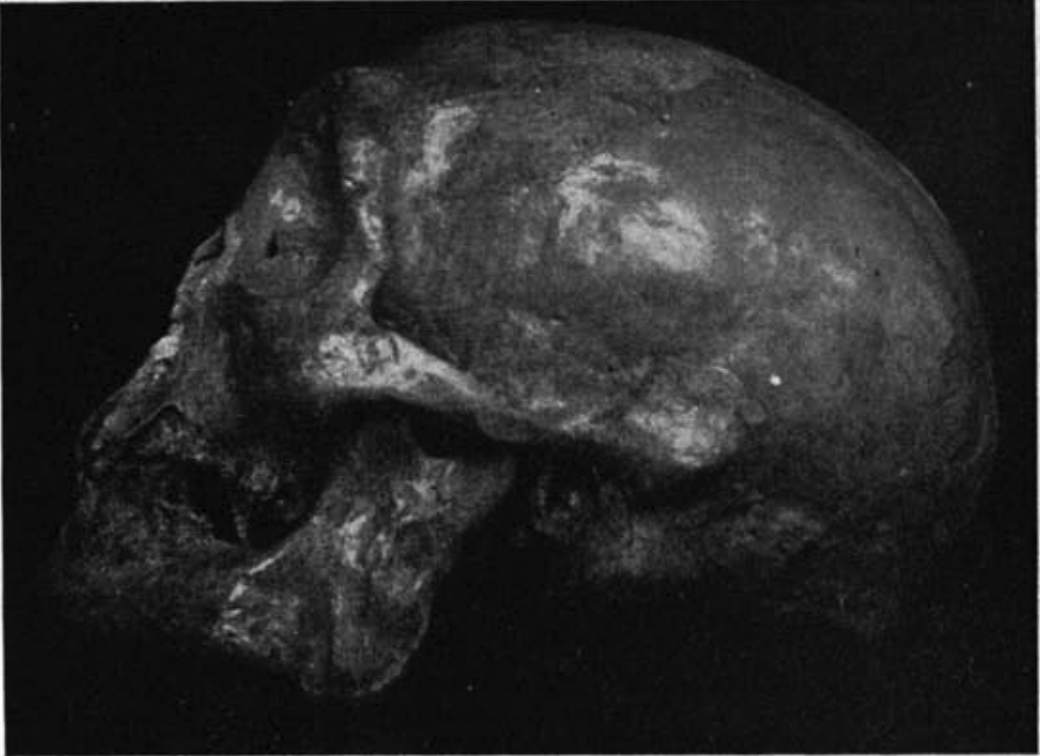
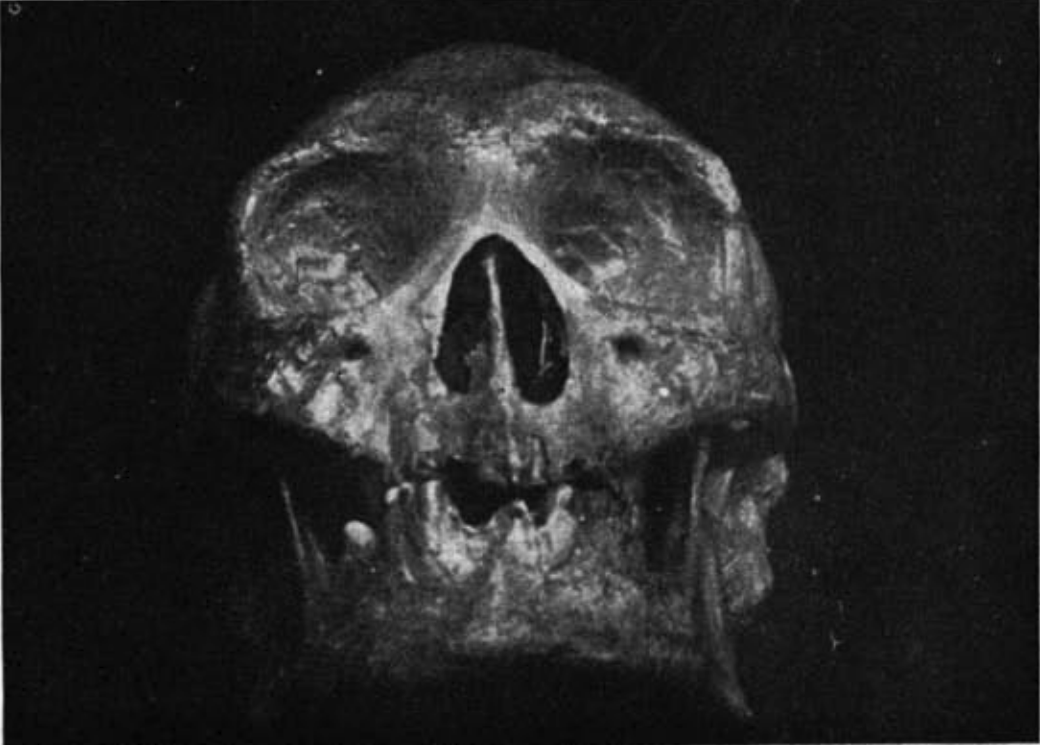
What set the Ellis County skull apart was the strange mix of features. Carter lists several traits that differ from the “average skull of modern man”: an exceptionally low forehead, massive brow ridges, a small cranial capacity, a sagittal crest along the top of the skull, and a very heavy occipital bone at the back of the head. The zygomatic arches (cheekbones) are described as heavy but still within the known range for recent humans, reinforcing that the overall impression of the vault is more archaic than the face.
In contrast, the lower part of the skull looks strikingly modern. Carter emphasizes that the mandible has a well‑developed chin, a relatively small maxilla (upper jaw), and teeth indistinguishable from modern human dentitions. In other words, if one had only the face and jaw to look at, nothing about the specimen would demand an ancient or non‑modern classification.
Sent to New York for expert examination
Because of these contradictions, the skull drew enough attention that it was sent to the American Museum of Natural History in New York at the request of Howard W. Blakeslee, the Associated Press science editor. There it was examined by Dr. Harry L. Shapiro and the eminent paleoanthropologist Franz Weidenreich, both authorities on fossil humans in the mid‑20th century.
Shapiro’s written comments, quoted in Carter’s report, are remarkably candid. He notes that when the outline of the Ellis County cranial vault is superimposed on that of Peking Man (Homo erectus from Zhoukoudian), the Ellis skull is “little if any higher” in absolute height, and that its brow ridges are “exceptionally heavy,” though still within the extremes of modern variation. This combination of a very low vault, flat brow region, and robust cranial bones gives what Shapiro calls a “pseudo‑primitive appearance,” which he believes is misleading once the modern jaw and face are taken into account.
“Frankly, I cannot offer any demonstrable hypothesis…”
Shapiro concludes that the skull is not truly “phylogenetically primitive” and therefore should not be considered a fossil human of an earlier species, but he openly admits that its peculiar mix of traits defies easy explanation. He suggests it might represent either an extreme local variant within modern humans or a “morphologically degenerate type,” yet concedes he cannot provide a demonstrable hypothesis to fully account for its morphology.
Crucially for time‑depth, Shapiro adds that if only the vault (skullcap) had been found on its own, it would have strongly suggested much greater antiquity than the complete skull actually warrants. He also notes that geology at the time allowed for something on the order of 25,000 years or more of human presence in the New World, leaving open the possibility that even anatomically modern skulls like this could be quite old in absolute terms.
Geological and archeological context
Carter’s brief report spends most of its space on description and expert opinion, but the context is equally provocative: the skull rested directly on Permian clay, in sands and gravels that themselves are far older than any accepted age for human occupation. This has led later commentators, especially outside mainstream archeology, to treat the Ellis County skull as a possible “out‑of‑place” human fossil embedded in pre‑human strata.
More cautious interpretations point out that road cuts, reworked sediments, and buried channels can bring younger remains down into older formations without requiring that people actually lived in the Permian. Modern syntheses on the Southern Great Plains still cite the Ellis County skull when discussing the range of anatomical variation among early and recent humans in the region, but they frame it as a morphologically extreme modern specimen whose stratigraphic history is complicated rather than as proof of a Permian‑age human.
Images and visual documentation
Carter’s 1942 article in the Proceedings of the Oklahoma Academy of Science includes three photographs: a side view of the Ellis County skull (Figure 1), a frontal view (Figure 2), and a picture of the road excavation along Commission Creek where it was found (Figure 3). These black‑and‑white plates show the very low cranial vault, prominent brow region, and the general setting of the Permian clay bank, and are the primary historical images associated with the skull.
Beyond those original plates, modern online discussions and social‑media posts about the Ellis County skull often reuse cropped or enhanced versions of the same 1942 photos or generic images of human crania, making it important to trace any illustration back to the Oklahoma Academy of Science proceedings for authenticity. There is no public indication that the skull is currently on display in a major museum; its present curation status is not clearly documented in available open sources.
Why the Ellis County skull still matters
Even though Shapiro and Weidenreich ultimately categorized the Ellis County skull as anatomically modern, the specimen occupies an important place in the story of American paleoanthropology. It shows how extreme the range of modern human cranial shapes can be, to the point that a complete skull can superficially resemble classic Homo erectus fossils when viewed only from the side or above.
For researchers and history‑mystery enthusiasts alike, the case also illustrates how geology, road construction, and fragmentary records can combine to create enduring puzzles about age and context. Whether read as evidence for a lost deep antiquity or as a cautionary tale about interpreting “primitive‑looking” skulls, the Ellis County skull continues to invite fresh scrutiny—and makes a compelling anchor story for anyone exploring the boundary between accepted prehistory and the anomalies that refuse to quite fit.
- https://ojs.library.okstate.edu/osu/index.php/OAS/issue/view/246
- https://ojs.library.okstate.edu/osu/index.php/OAS/article/download/3197/2910
- https://www.academia.edu/120275449/From_Clovis_to_Comanchero_Archeological_Overview_of_the_Southern_Great_Plains
- https://www.facebook.com/groups/1249866336420527/posts/1588206769253147/
- https://www.facebook.com/61558949182432/videos/the-ellis-county-skull-more-lost-civilization-%EF%B8%8F%EF%B8%8Fdive-deep-into-the-mystery-of-th/1162969965462424/
- https://ppl-ai-file-upload.s3.amazonaws.com/web/direct-files/attachments/28700284/89846b80-8f34-4abc-b574-59e0c2a80988/ellis-county-skull.html
- https://digitalrepository.unm.edu/cgi/viewcontent.cgi?article=2200&context=nmq
- https://www.chron.com/life/wildlife/article/mammoth-skull-texas-20060836.php
- https://www.youtube.com/watch?v=IXESBdhxF_0
- https://rockchasing.com/treasures-found-in-texas/
- https://www.youtube.com/watch?v=YAwq3FCi_0I
Gallery
Discussion (0)
Please sign in to join the discussion
No comments yet. Be the first to share your thoughts!