Lost Cities of the Maya: Echoes of a Forgotten Empire
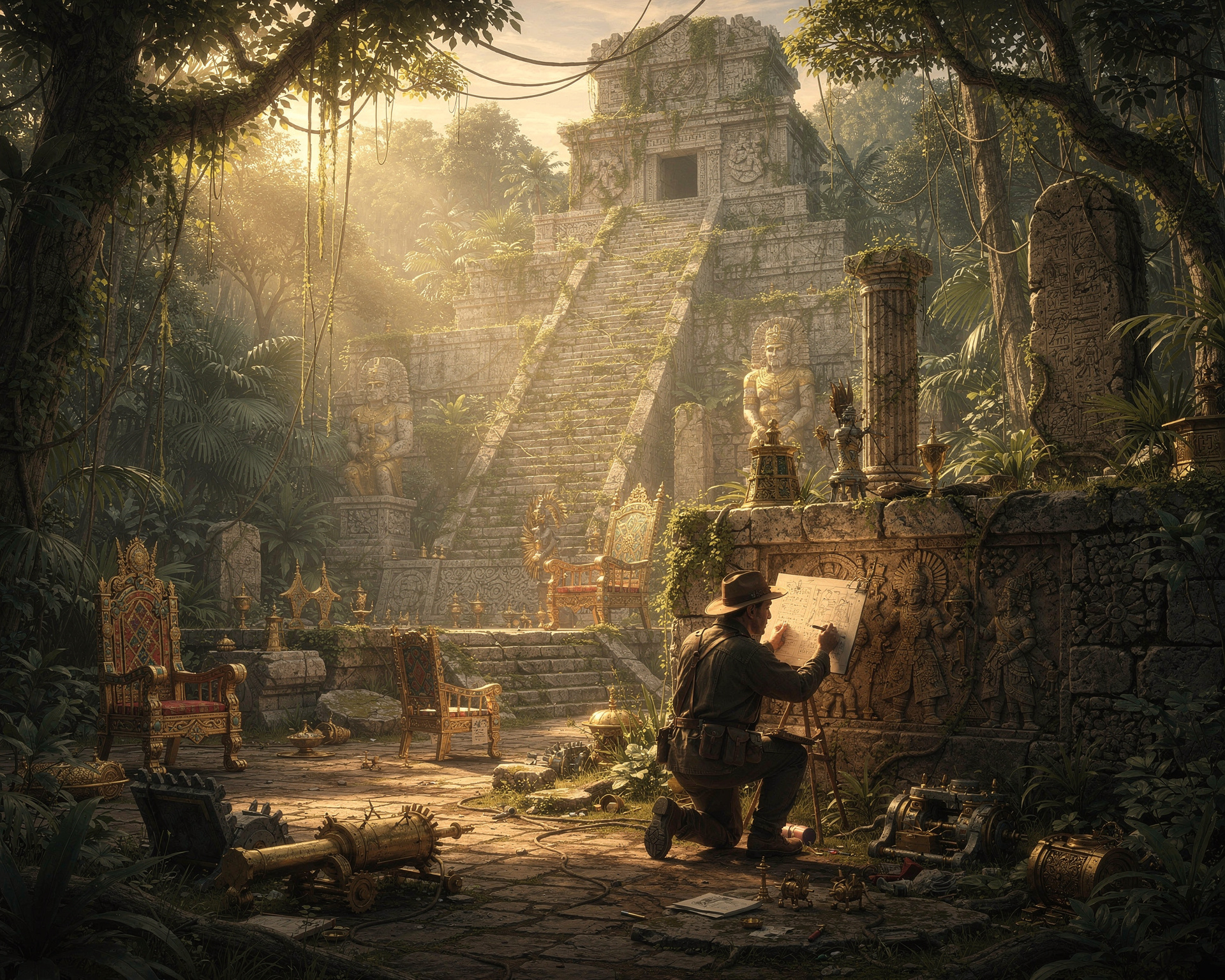
Pre-Historic Ruins
While archaeological, historical, and geographical societies are busily digging into the remains of ancient civilizations in Egypt, Syria, and Greece—sometimes uncovering broken statues, fragments of buildings, tools, or carved monoliths bearing brief hieroglyphic records of local history—there is, on this western hemisphere, a far larger and richer field for research that has remained strangely neglected. For more than three centuries, the vast ruins of Guatemala and Yucatan have lain almost untouched, even though they offer a more extensive and promising field of exploration than any yet worked in the Old World.
Only twice since the Spanish conquerors swept over Mexico and Central America—destroying many monuments that might have supplied missing links between modern times and a mysterious earlier age—has serious attention been given to the immense architectural ruins scattered through these regions. Explorers who did venture there visited, measured, and sketched more than a score of abandoned centers that had once supported a dense population, now remembered only through the shattered remains of huge, lofty, and richly sculptured temples, palaces, pyramids, fortresses, and terraced platforms.
From the ordinary objects of daily life very little survives. Few tools of labor or war, few household utensils, and scarcely any burial places or methods of sepulture have been identified, so that the heavy veil of mystery covering the origin of these structures has scarcely been lifted. The greater question—who were the mighty people who raised these vast works, and where are they now?—is as obscure today as it was in 1517, when the flag of European civilization was first planted upon their coasts.
Within the great ruins of Central America there is convincing evidence of a once-crowded and powerful population, apparently more numerous and capable than the peoples who possessed the region in later centuries. Their architectural remains reveal a grasp of physics, mathematics, mechanics, and picture or sign-writing; their carved figures, shown in elaborate dress, testify to a high development of the mechanical arts, of which only the barest traces survived among the inhabitants found there in the early sixteenth century. The splendor suggested by their surroundings—jewels, sculptured thrones, and weapons represented in relief—shows a cultivated sense of art and a skilled use of metals, even though actual tools, arms, or textiles have scarcely been discovered.
Some statues still preserve traces of their original coloring. And although certain features of the buildings, decorations, stone idols, and hieroglyphs faintly recall forms found among Old World ruins, the overall style and construction clearly belong to a distinct architectural tradition, independent of the classic schools of Europe or Asia.
In his narrative of exploration, Stephens observes that countless theories have been advanced to explain the first peopling of America. Some writers argue that the continent’s inhabitants formed a separate race, not descended from the same ancestor as the rest of humanity, while others claim they came from a remnant of antediluvian peoples who survived the Flood and thus represent the most ancient race on earth. Under the broad allowance of descent from the sons of Noah, Americans have been traced, in turn, to Jews, Canaanites, Phoenicians, Carthaginians, Greeks, Scythians, Chinese, Swedes, Norwegians, Welsh, and Spaniards; theorists have imagined continents joining and breaking apart, have resurrected the lost island of Atlantis, and even proposed that the ark itself came to rest within what is now the state of New York.
Until recently, the surviving monuments of the aboriginal peoples played little part in these speculations. Stephens quotes Dr. Robertson’s skeptical opinion of the ruins, then remarks that while caution may have been wise in Robertson’s day, a flood of new light has since poured in, opening the field of American antiquities to serious study. Confident that his own journeys, together with Catherwood’s and others’, had begun an inquiry that would not cease until the heart of the mystery was laid bare, he turns to rebuke the ignorance and indifference of Spanish-American society toward these remains.
In the United States, by contrast, the cutting of forests and the uncovering of ancient mounds and earthworks from the Great Lakes down through the Ohio and Mississippi valleys, the finding of mummies in a Kentucky cave, inscriptions on the rock at Dighton thought to be Phoenician, and the reported ruins of walls and a great city in Arkansas and Wisconsin, had already stirred the public imagination. These discoveries fed a strong belief that powerful, populous nations had once occupied the land and vanished, leaving no written history. Similar traces continue into Texas, and in Mexico the evidence grows clearer still.
The first to shed new light on the question was Alexander von Humboldt. He visited and gathered information about Mitla, or the “Vale of the Dead”; about Xochicalco, a mountain cut down and terraced, called the Hill of Flowers; and about the great pyramid or temple of Cholula. Unfortunately, he never reached, or at least never described, the ruined cities beyond the Valley of Mexico—cities buried in forest, silent, ruined, and nameless—whose existence only recently became known in Europe and the United States.
When reports of these sites began to circulate, however vague, they fired curiosity, though both Stephens and Catherwood admit they were somewhat skeptical at first and reached Copan more in hope than in firm expectation of marvels. Since the discovery of these ruined cities, the prevailing theory has been that they belonged to a people far older than the tribes encountered by the Spaniards at the time of the conquest, a race whose civilization had already declined or disappeared.
Source: https://www.loc.gov/resource/sn92067047/1889-12-04/ed-1/?sp=3&q=Arkansas+ancient+mystery&r=0.511,0.026,0.522,0.311,0
Gallery


Discussion (0)
Please sign in to join the discussion
No comments yet. Be the first to share your thoughts!