Last Stand of the Mound Builders: Giants, Obsidian Weapons, and a War of Extermination in Iowa
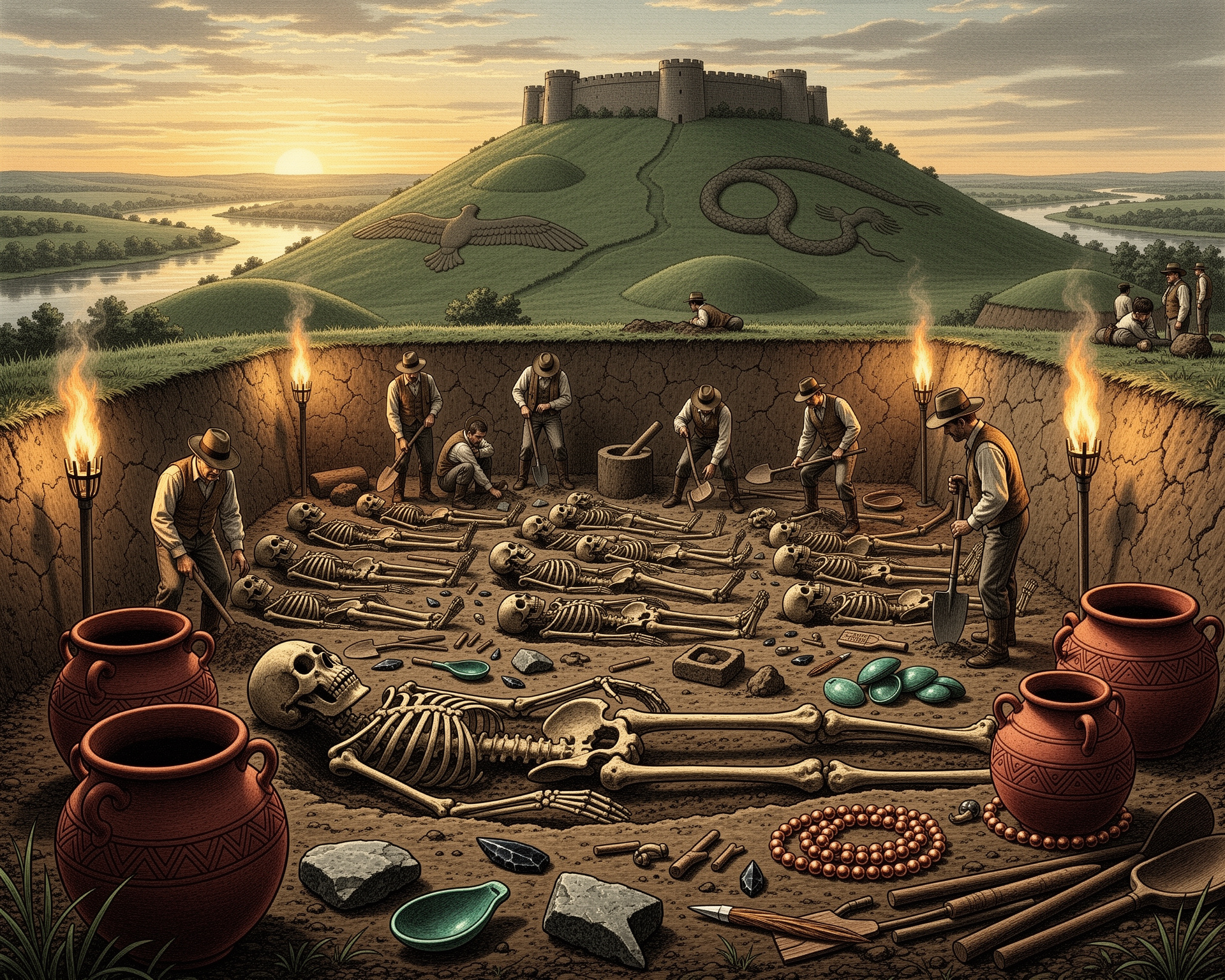
Northeastern Iowa's mounds and forts hold scars of a desperate final battle between the short-statured Mound Builders and invading warriors, revealed through skeletons riddled with arrows, spears, and crushed skulls. Local excavations uncovered nearly impregnable hilltop forts and hasty boulder defenses along the Iowa River and Bear Creek watersheds, where heaps of bones suggest one side was utterly annihilated. The Mound Builders, marked by their low, retreating foreheads, broad skulls, and advanced pottery, appear to have made their last stand in these canyons.
Forts of Desperate Defense
One fort crowns the watershed divide, with sheer 400-foot precipices dropping to Bear Creek on one side and the Iowa River on the other—a natural fortress a handful of defenders could hold against armies, barring modern guns. A mile away lies a crude boulder barricade, hastily piled without care, likely a cutoff party's temporary refuge amid frantic fighting. Arrowheads, knives, spear points, and tangled skeletons litter these sites, with some graves showing arrows embedded in bones or skulls pierced clean through from front to back.
Downriver, massive mounds—some so vast they would take 100 wheeled scrapers three years to build—brim with human remains. Regular burial mounds hold orderly rows of skeletons, deeply interred and heavily decayed, while chaotic heaps nearby preserve fresher bones minus only fingers and toes, topped with loose dirt as if thrown in haste. Skulls bear crushing wounds, ribs split by knives, pointing to a war of total extermination where the Mound Builders fell.
Giants Among the Fallen
Most Mound Builders stood compact at about 5 feet 4 inches, but outliers towered: one excavator unearthed a giant over 7 feet 6 inches tall, judged by a 25-inch shin bone reaching past his knee. Its massive jaw—1.75 inches deep, 6.5 inches around the base, 5.5 inches across—held perfect teeth, buried with a beautifully shaped pot over the mouth, strings of beads, and war implements, marking a great chief. Single graves on river bluffs mix Mound Builder remains with those of a taller, Indian-like race, distinguished by skull shape, obsidian tools, and copper artifacts unique to the Builders.
Weapons, Pottery, and Lost Arts
Mound Builder war gear—spears, arrows, clubs, axes—crafted from obsidian (volcanic glass or "sugar flint") and rare granite from Alleghenies, New Mexico, or Arizona, shows superior workmanship over invaders' tools. Graves yield copper spears, arrows, and hardened bead strings, plus animal-, bird-, and snake-shaped mounds like a spread eagle or serpent devouring prey. Pottery ranges from half-pint reddish pots to three-quart kettles and washtub-sized vessels, often with lugs or ears, scalloped edges, and clam shell "death spoons" nearby; black ones mimic iron-tinctured clay firing.
Corn mills, chisels, and drills abound but seem abandoned, their makers exterminated. Pots—swelled bodies, flaring mouths, placed over mouths, shoulders, or heads—evoke old-fashioned kettles, hinting at a cultured people who farmed, crafted, and fought until overrun. These Iowa earthworks stand as tombstones to a vanished race, their final battle etched in bone and blade.
Source:
https://www.loc.gov/resource/sn99021999/1897-12-25/ed-1/?sp=6&q=Arkansas+Mounds+skeleton&r=0.268,0.022,0.563,0.366,0
Gallery
Discussion (0)
Please sign in to join the discussion
No comments yet. Be the first to share your thoughts!