“Giants of the Olden Time: When Science Met Myth in the Age of Discovery”
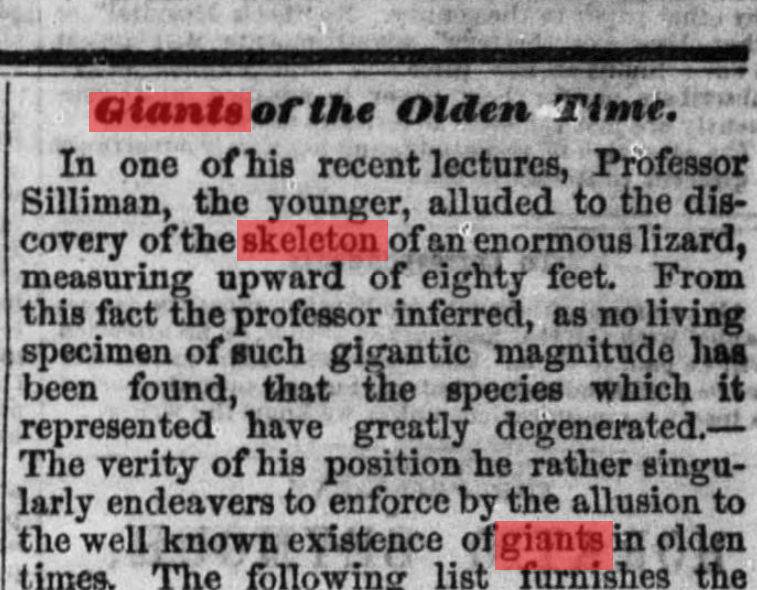
Legacy of Legends: “Giants of the Olden Time” and the Age of Discovery
In the 19th century, newspapers often blurred the line between science, speculation, and myth. A curious example can be found in an old article titled “Giants of the Olden Time,” which recounted tales of colossal skeletons and legendary beings said to have once walked the earth.
According to the story, Professor Benjamin Silliman Jr.—a respected American scientist and lecturer of the era—spoke of an extraordinary fossil discovery: the remains of an immense lizard said to measure over eighty feet in length. Silliman used this ancient reptile as evidence that both animals and humans of prehistoric times were once much larger than their modern descendants. To illustrate his belief, he referenced reports of “giants” from historical and biblical traditions, drawing from a collection of stories that were widely circulated through European chronicles.
The old account included a series of astonishing examples:
- A giant displayed at Rouen in 1830, said to have stood eighteen feet tall.
- Ancient Roman accounts of a man from Arabia nearly ten feet high, brought to Emperor Claudius.
- The head of a being with ninety teeth discovered in a cavern on Tenerife, its owner estimated at fifteen feet tall.
- Burial finds in France and Sicily reporting skeletons from eighteen to thirty-three feet long, with skulls “the size of hogsheads.”
- A particularly detailed case near Dauphiné, where a tomb thirty feet long bore the inscription “Reutolochus Rex,” with a skeleton said to measure over twenty-five feet.
Many of these claims, viewed through the lens of modern science, reflect 18th- and 19th-century fascination with the idea that humans once reached enormous sizes—stories often inspired by misidentified fossil remains, extinct megafauna, or even deliberate exaggeration by showmen and antiquarians eager to attract attention. At a time when paleontology was still young, it wasn’t uncommon for giant bones of elephants or mastodons to be mistaken for those of “ancient humans.”
Interestingly, the original article diverged sharply in tone midway, shifting from wonder to political commentary about the American economy and corruption during the Reconstruction era—an example of how early newspapers blended unrelated reports within the same column. The discussion of “giant skeletons” thus appeared side-by-side with heated opinions about gold standards, taxation, and government ethics.
For modern readers, this juxtaposition tells us something important: 19th-century journalism was as much about spectacle and persuasion as it was about truth. Yet amid the sensationalism, these old “giant” stories capture a deeper human curiosity—a lingering desire to believe that the earth once held beings of immense stature, shrouded in ancient mystery.
Source: https://www.loc.gov/resource/sn83016107/1868-09-04/ed-1/?sp=1&q=Giant+skeleton+Arkansas&r=0.484,-0.009,0.797,0.518,0
Discussion (0)
Please sign in to join the discussion
No comments yet. Be the first to share your thoughts!