Ellis County Skull
Here’s a clearer, more readable, and smoothly flowing version of the text about the Ellis County skull:
The Ellis County Skull: A Fascinating Discovery
This case highlights the existence of unusual skulls, distinct from modern human skulls, found in the Americas. Recently, someone from Oklahoma shared images of a strangely shaped, elongated skull discovered by a construction crew. This prompted a closer look at the Ellis County Skull, which offers intriguing insights.
A Preliminary Report on the Ellis County Skull
By T.C. Carter, Northwestern State College, Alva
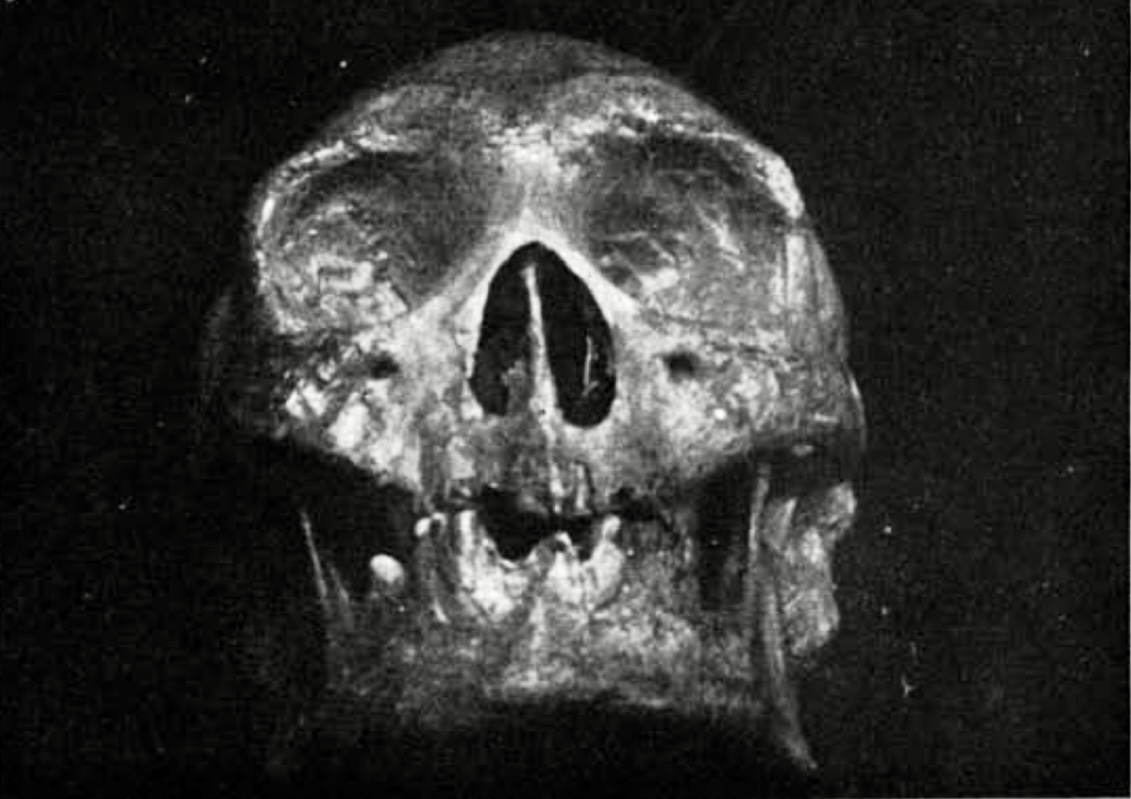
In 1937, Richard Henderson and Earl Gourley uncovered the Ellis County Skull approximately 25 feet below the surface. The skull was found in sand and gravel mixed with Permian clay on the south bank of Commission Creek, near Bishop in Ellis County, Oklahoma, during road construction excavation.
The skull was nearly complete when discovered, requiring only minor restoration. Most bones were present in sufficient quantity, allowing for a confident and accurate reconstruction.
Distinctive Features of the Ellis County Skull
Compared to an average modern human skull, this specimen shows several notable differences:
Forehead: Unusually low Brow Ridges: Massive supraorbital ridges Cheekbones: Heavy but within normal range Cranial Capacity: Small Sagittal Crest: Pronounced Occipital Bone: Thick at the back of the skull
In contrast, the lower jaw and face fall within the normal range for modern humans, exhibiting:
Well-developed chin Small upper jaw (maxilla) and dental arcade Small teeth and molars Minimal jaw protrusion (prognathism) Narrow vertical jawbone (rami) Elongated mandibular process Well-developed spines on the inner surface of the chin
Overall, the entire lower jaw is indistinguishable from modern human types.
Expert Analysis
At the request of Dr. Howard W. Blakeslee, science editor of the Associated Press, the skull was examined by Dr. H. I. Shapiro and Professor Franz Weidenreich at the American Museum of Natural History, both experts in fossil humans.
Dr. Shapiro observed:
The skull has an extremely flat brow and low cranial vault, similar in height to the fossil known as Peking Man. The heavy brow ridges fall within the range of modern humans but give the skull a superficially primitive appearance, which can be misleading. The jaw and face clearly belong to a modern human type, so the primitive look is limited to the skull vault. The peculiar features of the skull could represent an extreme local variant or a morphologically degenerate form. If only the skull cap had been found, it might have suggested an older evolutionary age.
Dr. Shapiro also noted that while the skull is not primitive in evolutionary terms, geological evidence suggests humans may have been present in the Americas as far back as 25,000 years or more.
Visual Documentation
The report includes photographs showing side and front views of the skull, as well as images of the excavation site along Commission Creek, highlighting the Permian clay where the skull was found.
Sources A Preliminary Report on the Ellis County Skull (PDF) Historical Marker Program | Oklahoma Historical Society Special Publication 94-1 - Oklahoma Geological Survey (PDF) Archeological Overview of the Southern Great Plains (PDF) Synopsis of Native, Recent Mammals of Ellis County, Kansas (PDF) Water Quality Oklahoma 2012 (PDF) Discussion on Giants - Facebook Annual Report - UNC School of Medicine (PDF) Estimates of Median Flows for Streams on the 1999 Kansas Surface (PDF)
Gallery


Discussion (0)
Please sign in to join the discussion
No comments yet. Be the first to share your thoughts!